


S2:E1 (Part 1)
The Importance of Paying 70,000 Employees on Time
TAL CLARK | APRIL 29, 2026
Listen to Audio

Watch on Video

Episode Transcript

Tal Clark: Hello everyone and welcome to the Instant Payments podcast. I’m your host, Tal Clark. I’m the CEO of Instant Financial, a fintech company that’s modernizing payments and payroll for today’s hourly workers and their employers. I’ve worked in the payments industry for 30 years at companies like Fiserv and Money Network, and I’m glad you’re tuning in today.
If you like what you hear, please do us a favor and subscribe, leave a review or suggest a future guest. Our journey continues today with our first episode for season two. This podcast features payments and payroll leaders to discuss some of their challenges and what technologies they’ve used to improve their workplace and the lives of their workforce.
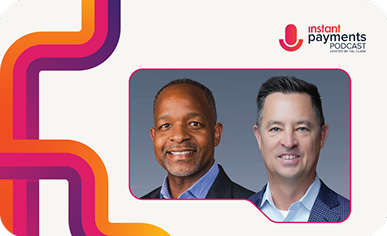
Today’s episode is a special one. We’re joined by Ben Elliott, the CFO of Randstad North America, one of the largest talent organizations in the world. Ben leads the North American Financial Shared Services Organization, a [00:01:00] team supporting $6 billion in operations with offices in Atlanta, Toronto, Montreal, and Hyderabad, India.
His work has been rooted in lean leadership and he has driven major digital transformation through automation, robotics, process automation, and now artificial intelligence. Beyond his CFO role, Ben serves as a business and financial advisor to Spherion’s Franchise leadership team, is a member of the Metro Atlanta Chamber of Commerce board, and sits on the American Staffing Industry Board of Directors. He lives in Dunwoody, Georgia with his wife Kathy, and is a proud father of three daughters and a grandfather to seven. Ben, a big welcome. How are you today?
Ben Elliott: Hey Tal. Good to be here. Good to be here. I want to correct one thing. I’m actually the US CFO, not the North American CFO, but everything else is actually very accurate.
Tal Clark: You may wanna correct [00:02:00] my pronunciation of the city in India as well.
Ben Elliott: Well, it’s Hyderabad. So although, some people call it actually, pronounce it phonetically, so Hyderabad, but it’s Hyderabad.
Tal Clark: All right. Well good. I knew I was gonna butcher that, so appreciate the help.
Ben Elliott: Not a problem.
Tal Clark: So for our listeners who may not be as familiar, Randstad is one of the top recruitment staffing firms in the world. Can you give us an overview of how you serve both employers and talent at Randstad?
Ben Elliott: Absolutely. So, from an employer’s standpoint, what we’re really providing Tal is access to workers. And, from an employer standpoint, we really are providing flexibility and the ability to really manage your labor force in which we actively and proactively [00:03:00] participate in.
And so from a specialization standpoint, we work a across a broad spectrum of industries. So whether that’s manufacturing and logistics, whether that’s technology, and all facets of the tech world: healthcare, life sciences. We do clinical trials, we participate, whether it’s statement of work or solutions, actual consulting projects.
So it’s a wide variety that we offer to the employers in the marketplace. And then to the talent, it’s really about access to the jobs and access to actually develop your skills and to establish a career path. And I think that’s that. When I sit back, I look at one of our former CEOs and he used to talk about what does talent, what are talent coming to Randstad for?
And it’s really two things. One is they’re coming [00:04:00] to Randstad to seek employment, a job so that they can feed their families and establish a career. And the other thing is they wanna make sure that they can get paid on time, which will obviously dovetail into our topics later.
Tal Clark: Yep. Well, that’s great. And touch a little bit on the size and numbers at Randstad. We haven’t talked about this in a little bit, but how many are employed today at Randstad? And if you wanna break that down by industry, that’s fine, but just in general, tell us a little bit about the scope of Randstad.
Ben Elliott: Globally Randstad puts on a daily basis over 300,000 people to work every day across the world. In North America, those numbers are in the 70,000 plus range, depending on time of the year, seasonality and the like. And if you look at it, I would say from a 50-50 standpoint, in terms of our size of our company, we’re about 50% commercial [00:05:00] staffing in the US and 50% professional staffing.
And that professional staffing would be your engineering, it would be your technology positions, finance and accounting, life sciences, those groups from a size.
Tal Clark: Okay. Okay. Really impressive and great organization. So we enjoy the opportunity to work with you guys and see what you do in the space. So you, we touched a little bit about on your current role and some of the activities you have going on in Atlanta market as well, but you really had an impressive career in finance and leadership.
Share a little bit about your professional journey and what brought you to Randstad.
Ben Elliott: I started my career with a company that’s no longer in business, Arthur Andersen. So I think most people know the story of Arthur Andersen. From my perspective: bad timing, but [00:06:00] certainly an excellent company from development. So at that time it was the Big Eight. Now’s the Big Four.
So I started from a career standpoint as an auditor, and then as I got into private industry and finance roles, but I had tremendous experience in logistics, construction, manufacturing, and even your former industry with the electronic payment systems. And what brought me to Atlanta, so I was based in Chicago and I came to Atlanta about 30 years ago actually to do a turnaround of a third-party logistics operation. And so we had about a million square feet of operation here in Georgia and then we had national account wise, I probably had another 2 million square feet of operation, so pretty big size.
Randstad was my staffing company and so I didn’t go to work for Randstad right away. I, they were [00:07:00] my staffing company for about four years, and then I left, went back into finance, and about four years later, Randstad came knocking at the door. Asked if I would become the CFO for their commercial staffing division at the time, and it was a turnaround.
And today, now my role has evolved into leading the North America Financial Shared Services Operation.
Tal Clark: Super. Well, it’s a great career and you have a, your education is from Notre Dame. We’ve talked about that. You’re pretty much a Notre Dame fan, I believe, right?
Ben Elliott: Oh, pretty much so. Absolutely. Absolutely. It’s a good place.
Tal Clark: Good deal. I have not had the opportunity to go up there, but I certainly want to visit that campus at some point, maybe for a football game or something.
But, in any case, Ben, well, that’s a great background and Randstad has an incredibly complex workforce. You [00:08:00] guys with thousands of temporary employees across many sectors at a high level. Talk a little bit about your HCM process, accounting and finance process, just to make sure that they’re paid on time and accurately.
Ben Elliott: I mean, look I was thinking about that question. And first of all, there’s not a lot of payroll departments even in Atlanta that handle that complex of a group. When you’re thinking about it, you think about somebody who’s handling thousands of employees, union contracts, all those complexities.
We’re not union, but that’s probably the best correlation of somebody who has to deal with all the different shifts and all the different activities there. I think what also compounds, especially in the United States as you look at it, we’re in 40 plus out of the 50 states, so you have to know the state regulations [00:09:00] as well as the federal regulations in that area.
Our platform is PeopleSoft. We’ve been on this platform for several years. It has proven to be a workhorse for us. And in there, we supplement it with ADP for certain, specific things. But you know, what it takes is it takes from a leadership standpoint, somebody who is very much attention to detail.
Somebody who is very process oriented and somebody who has a high customer service quotient. And that’s really how we’ve built the team from a group standpoint. And, it’s our obligation that everybody who works on a given week is paid by Friday of the following week.
And, there’s… our goal is better than Six Sigma. We want no exceptions. And that’s really based on the premise that [00:10:00] people have a right to their pay. And the other issue is most people from a work standpoint, and especially when you get into the commercial staffing, they count on having that pay and that money in their bank account on Friday.
Tal Clark: Well, that makes a lot of sense, and that’s good to hear. How many different payroll cycles are you guys managing on a weekly or biweekly basis?
Ben Elliott: Well, historically we used to run payroll multiple times a day. Actually, we’re down to three cycles for our external talent. And so, that has really helped us, but it’s really… we have used tools to really process-map, process-mine and really track every individual who is working this week on an assignment.
We know the status of their time if it’s been entered into the system. We know that up to the minute and so we can track that. And so if somebody has not [00:11:00] submitted a time card or there’s been a problem with the time clocks that they’re participating in, we pretty much know that real time and then are able to reach out, and that’s how we’ve been able to get down to these three cycles a week.
Tal Clark: Well that’s, that was, I can imagine that’s a significant challenge, but managing three cycles compared to I know much many smaller organizations in the staffing space that are doing many times more than that. So it’s certainly you guys have it managed very well. What does… you mentioned this a little bit, if they work on in a week, you wanna make sure they’re paid on Friday?
I mean, that’s pretty, that’s a pretty direct and solid indicator of success, I think, at least from your employees’ perspective. What does success look like for your payroll operations team? Are there other sort of metrics and parameters and timing type things that you guys look for and you look to hit?
Ben Elliott: Well, I, I kind of [00:12:00] touched on it a little bit. You know what it starts from a process standpoint of getting all the time cards in. So, from an, from a overall standpoint, we’re, believe it or not, still dealing with manual time cards, time sheets. Interesting… we will get a time card submitted on a napkin, signed by somebody, and so you figure out how you’ve gotta be able to key that information in and get it in.
So what we’ve done from a success standpoint is we run both onshore and offshore. So this is where our team in Hyderabad really helps us, Tal, so that we’re basically on Monday, Tuesday, 24/7, going after every timecard. What comes into the queue, we’re able to clear out the queue for each subsequent day because we’re using the on and offshore from a complement standpoint.
And then, as I indicated, the goal is pay everybody, by Friday by five o’clock. [00:13:00] And so from a challenge standpoint, that’s where we have put in place systems that as we track it, we clearly know what, what happens. We had an incident two years ago where we were just rolling out this technology. We were actually in pilot phase with the technology and we had a major global timekeeping system, was hit with a cyber attack.
We were able to go in and identify all of those with the system that we were in pilot. We just went ahead and implemented and said, let’s go. We don’t have any more time to test. Let’s see how it works. Not one of those people missed a paycheck. So it’s a little bit of having that mentality, that bias, and that understanding.
And we believe that’s a, it’s an important differentiator to our talent. They know when they come to work for us, they’re gonna get paid on time. And, and it’s from an accuracy standpoint, that’s probably one of the other key [00:14:00] metrics. Our accuracy is in the 99% plus.
Tal Clark: Okay. That’s great. Well, and we’re working with you to make sure they’re not only paid on time, but they have access to their wages as they’re earned, which can be every day. So, we started that back in 2021. We’ve helped you to issue $480 million in payments, over 114,000 of your talent over that period of time.
Talk a little bit about, because some of this was starting just as I was getting here, we were getting started. What led the decision to implement wage access and why was it important to make faster pay available for your workforce?
Ben Elliott: I think it comes from two-fold. Number one, it was certainly, number one, it was the technology was finally catching up and being stable and reliable. I think that’s a critical piece. And so, Instant answered the call on a lot of [00:15:00] variables that we had in making it available for early access.
Employers were starting to implement it. They were certainly driving it, but so is the talent, so you’re a talent working, we’re asking about it. And so it really became a competitive issue as well. And so from a program standpoint, we looked at several different programs and we selected Instant because, frankly, you all have the ability to meet the requirements that we had.
And, frankly, you were easy to work with. And I can’t say that enough because sometimes you work with companies who just are inflexible and we were able to design a program for early access that met the needs of our operations from a control standpoint, from a business control, as well as through the ability to have it work for our employees and be [00:16:00] easy. Look, it’s easy to enroll, it’s easy to participate in the program. And it’s digital, right? So the administrative side is limited and it’s digital. It’s clean and that’s what’s an important factor for us.
Tal Clark: Well, that’s great. And look obviously we’ve learned a lot, a ton from you guys about the staffing space and providing earned wage access in a staffing space, which I’m not sure many others have been able to accomplish. It’s honestly, it’s a difficult market, right? There’s some things we have to do that are unique from a time and attendance perspective, and you guys work with us on that to make sure we have the data. So it’s really been all hands on deck and, working on both sides to make sure we’re able to deliver it in the way that meets your expectations and meets the employee’s expectations. Ben, this has been great. Thank you so much for joining us today. Your leadership at Randstad and commitment to rethinking how payroll and finance support both talent and clients is inspiring for our [00:17:00] audience.
You can find Ben on LinkedIn by searching for Ben Elliot, Randstad North America to our listeners. You can follow along with new episodes at instant.co/podcast and subscribe wherever you get your podcast. And as always, share the episode, leave a review and suggest a future guest. Thanks for tuning in to season two of the Instant Payments Podcast.
How Instant Tips Helps Employees
From faster tip distribution to higher employee satisfaction, Instant Tips delivers results across industries. Businesses
save time with automated payouts, reduce cash-handling risks, and give team members the convenience of digital
access to their tips. Explore our resources to see how Instant Tips can make every shift more rewarding.
PodCast
Tal Clark interviews Dr. Martin Armstrong, VP of Payroll of Shared Services.

Case Study
Ultra Steak Inc. is a long-established restaurant company headquartered…

Blog
Digital tipping apps replace cash handoffs with instant, automated payouts….


