
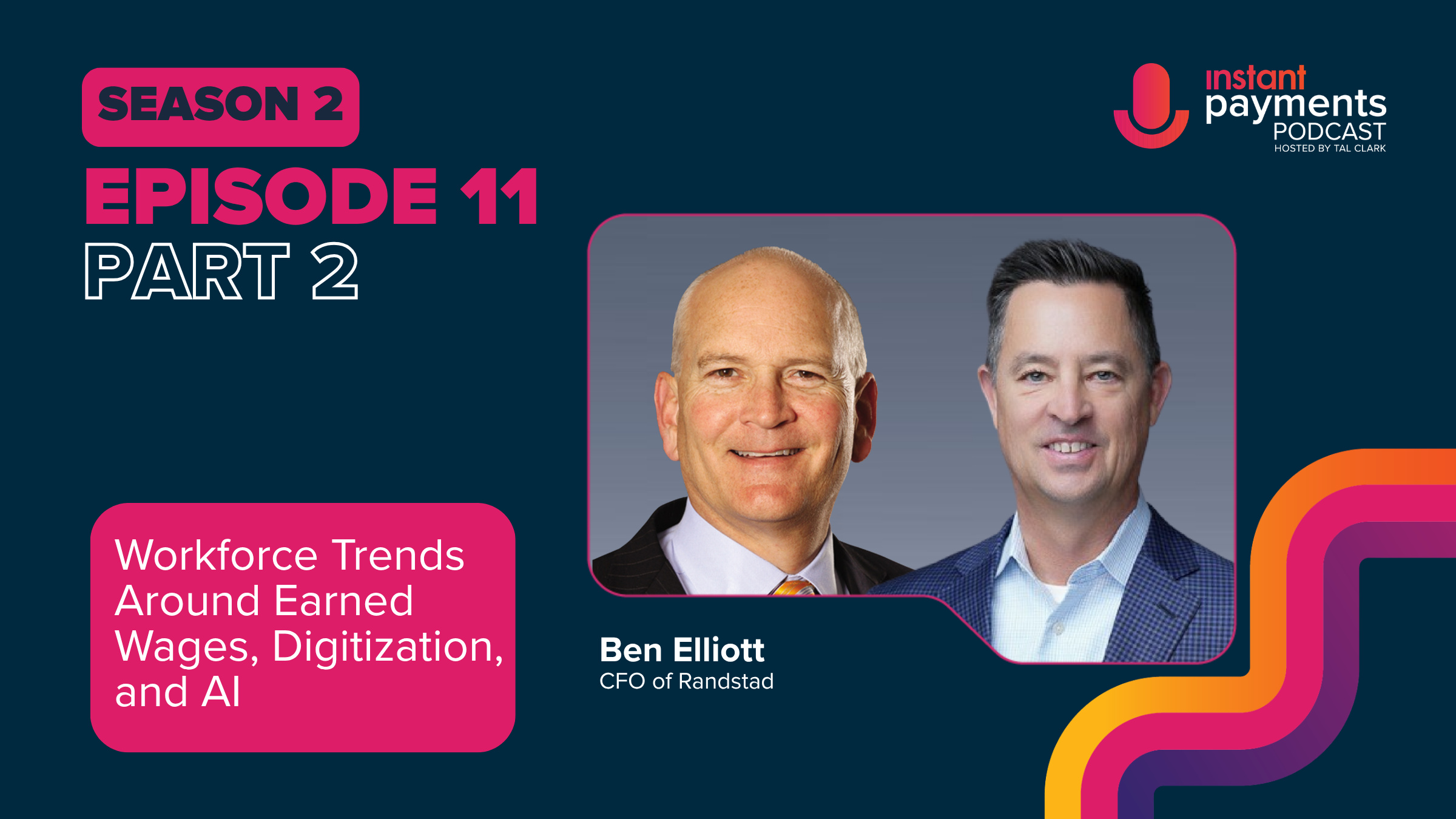
In Ep 11 Part 2 of the Instant Payments Podcast, Ben Elliott, CFO of Randstad, shared a front-row perspective on how workforce expectations are evolving.
What emerged from that discussion is a clear theme: the way people work, get paid, and interact with employers is undergoing a fundamental shift. And at the center of it are three powerful forces: on-demand wages, AI, and a redefinition of the employee experience.
The Rise of On-Demand Pay and Changing Expectations
For decades, payroll operated on fixed cycles — weekly, biweekly, sometimes even monthly. That structure made sense in a world where financial systems were slower and workforce expectations were more rigid.
That’s no longer the case.
“There’s been a psychological shift,” Elliott explains. “People now believe they have a right and access to their pay on a daily basis, as opposed to waiting one week or two weeks.”
This shift isn’t limited to hourly workers. According to Elliott, demand for early wage access spans across workforce segments.
“It’s not just limited to your lower wage, hourly workers… it really appeals to the entire workforce.”
In many ways, this change mirrors broader consumer behavior. Today’s workforce is accustomed to immediacy, whether it’s streaming content, ordering food, or receiving next-day deliveries. That expectation naturally extends to pay.
For employers, this has transformed earned wage access (EWA) from a niche benefit into a competitive necessity. As Elliott noted, the availability of early pay is not just a perk — it plays a direct role in workforce outcomes.
“The fact that the program’s there helps us recruit people, but it also is an important retention feature.”
Beyond perception, the impact is measurable: improved shift adherence, reduced call-outs, and stronger retention — all of which directly affect operational performance.
AI Is Enhancing, Not Replacing, the Workforce
While much of the conversation around workforce transformation focuses on automation, Elliott emphasized that artificial intelligence is playing a more nuanced role in practice.
Rather than replacing jobs, AI is increasingly being used to enhance productivity, improve processes, and upskill employees.
“What we’re actually seeing is AI is enhancing the quality of people’s work,” Elliott explains. “It’s giving us an opportunity to upskill what people do.”
At Randstad, that means investing in training and ensuring employees understand how to use AI tools effectively within their roles. Teams are being equipped not just to adopt the technology, but to apply it in ways that create real value.
At the same time, there are clear boundaries around where AI should and should not be used — particularly in hiring.
“There’s a lot of rules and regulations… you can’t really use AI for the decision process in the selection of a candidate,” Elliott notes, pointing to the importance of avoiding bias in hiring decisions.
Instead, AI is being applied to improve efficiency in areas like identity verification, compliance, and administrative workflows — helping organizations manage increasingly complex hiring environments.
This balance is critical. While AI can drive efficiency and productivity, Elliott emphasized that it cannot replace the human element.
“You can’t lose the human element… that’s critical.”
A Broader Redefinition of Work and Retention
While pay and technology are central to these changes, they are part of a broader shift in how employees evaluate work.
One of the most consistent findings, according to Elliott, is the importance of the employee experience, particularly the role of managers and workplace stability.
“The manager… is the catalyst to that employee retention,” he explains, noting that strong leadership often determines whether employees stay or leave.
At the same time, traditional career paths are evolving. Instead of linear progression, workers are increasingly building “career portfolios,” gaining diverse experiences across roles and industries.
And perhaps most importantly, work-life balance has emerged as a defining factor in retention. Employees are not just evaluating salary, they’re evaluating how work fits into their lives.
The Bottom Line
The future of work is not being defined by a single innovation, it’s being shaped by a convergence of trends.
Workers want faster access to pay. They expect digital-first experiences. They value flexibility, balance, and strong leadership. And they are making decisions about where to work based on those factors.
For employers, the takeaway is clear: adapting to these expectations is no longer optional.
It is essential to staying competitive in a rapidly evolving workforce.
🎧 Listen to the full conversation with Ben Elliott on the Instant Payments Podcast at instant.co/podcast or wherever you get your podcasts.