
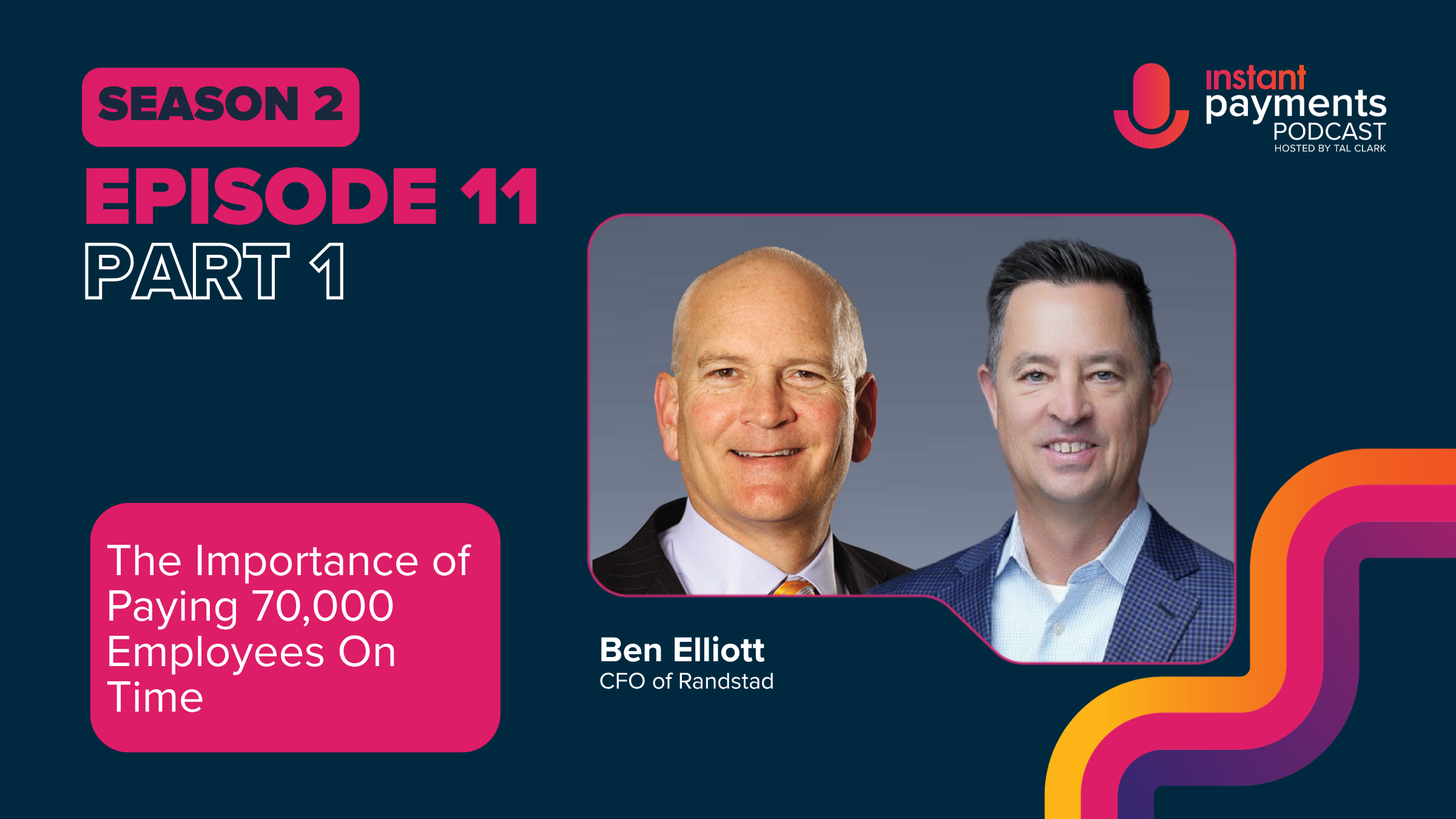
To kick off Season 2 of the Instant Payments Podcast, Instant Financial CEO Tal Clark sat down with Ben Elliott, CFO of Randstad USA, for a conversation that underscored just how much the world of payroll is changing.
For decades, payroll has been built around a simple construct: work a week, get paid the following Friday.
But for one of the largest staffing firms in the world, that model is no longer enough.
At Randstad, where more than 70,000 workers across the U.S. rely on timely, accurate pay each week, payroll has always been a mission-critical function. As Elliott explains, the organization has built its operations around delivering on that promise with precision.
“People have a right to their pay,” Elliott says. “And most people… count on having that money in their bank account on Friday.”
From On-Time Pay to On-Demand Pay
In a traditional payroll environment, success is measured by accuracy and timeliness. At Randstad, that means navigating a highly complex system — managing workers across 40+ states, multiple industries, and a wide range of roles and assignments.
“There’s not a lot of payroll departments that handle that complex of a group,” Elliott explains. “You’re dealing with thousands of employees, multiple states, different regulations…”
Despite that complexity, the expectation from workers has always been simple: if I worked, I should get paid. What’s changed is when they expect access to those earnings.
“Employers were starting to implement earned wage access, but the talent was also asking about it,” Elliott says. “So it really became a competitive issue.”
For a staffing company, where attracting and retaining talent is core to the business model, that shift is significant. Pay is no longer just a back-office function, it is a key part of the value proposition to workers.
Delivering Modern Pay at Scale
To meet these evolving expectations, Randstad partnered with Instant Financial to introduce earned wage access (EWA), enabling workers to access a portion of their earned wages before payday.
Since implementation in 2021, Randstad has delivered more than $480 million in payments through Instant, supporting over 114,000 workers with faster, more flexible access to their earnings.
Importantly, this capability was layered into an already complex payroll environment without compromising control or accuracy.
“We selected Instant because you all had the ability to meet the requirements that we had,” Elliott explains. “And frankly, you were easy to work with — and I can’t say that enough.”
The solution needed to integrate seamlessly, maintain compliance across jurisdictions, and operate at scale, all while remaining simple for employees to use.
“It’s easy to enroll, it’s easy to participate in the program. And it’s digital… it’s clean and that is important to us,” Elliott adds.
The Future of Pay in Staffing
For organizations like Randstad, the evolution of payroll is not about replacing what works, it’s about building on it.
Ensuring that 70,000 workers are paid every on-time will always be essential. But increasingly, that is just the starting point.
Modern pay means giving workers flexibility, transparency, and access. It means recognizing that financial needs don’t follow a fixed payroll schedule. And it means using technology to bridge the gap between when work happens and when pay is available.
As Elliott’s perspective makes clear, the organizations that succeed in staffing will be the ones that embrace this shift, combining operational excellence with a more responsive, employee-centric approach to pay.
🎧 Listen to the full conversation with Ben Elliott on the Instant Payments Podcast at instant.co/podcast or wherever you get your podcasts.